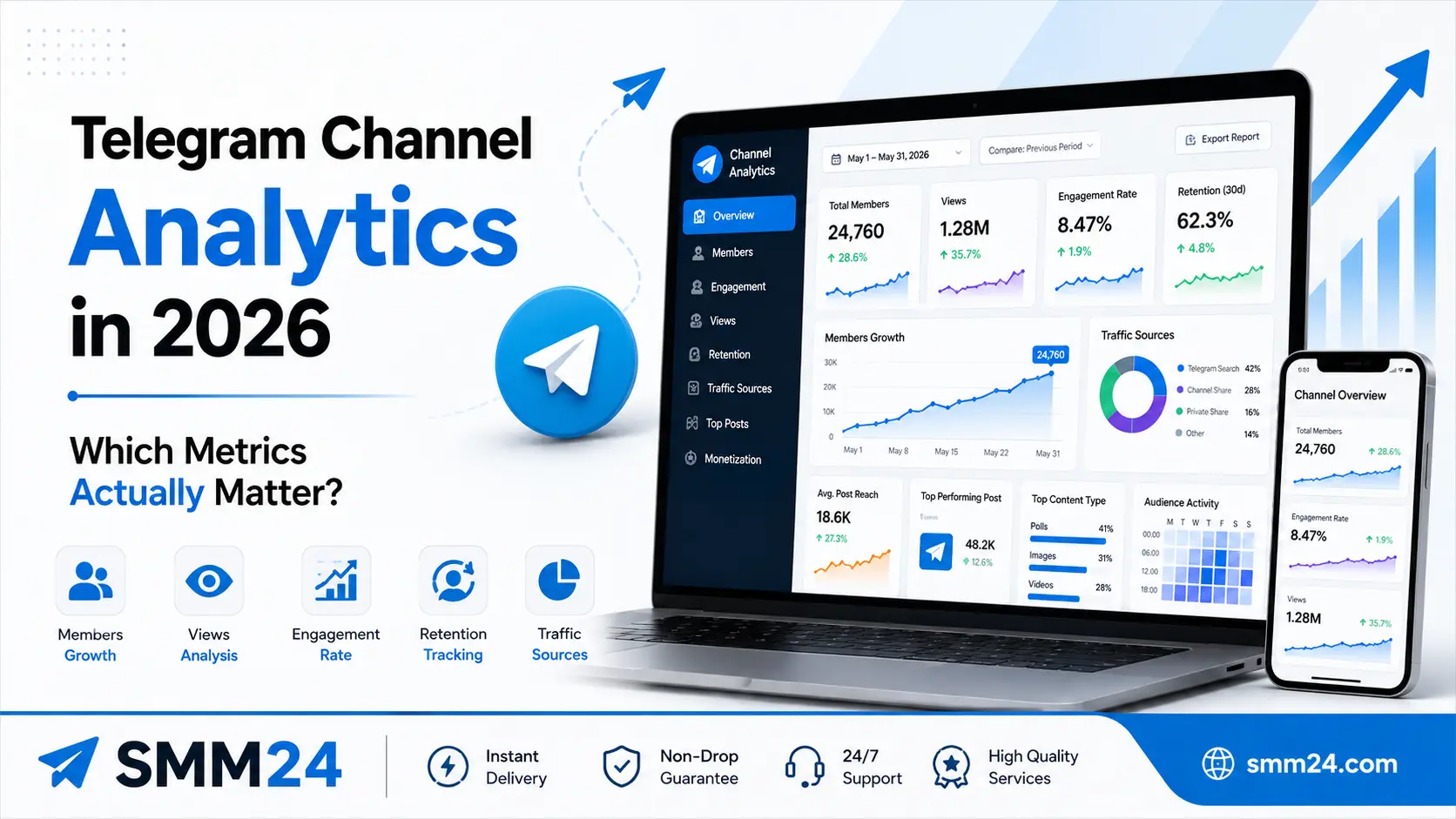
Telegram Channel Analytics in 2026 – 11 Metrics That Actually Matter (And How to Improve Them)
A channel with 8,000 highly engaged subscribers can often outperform one with 80,000 passive members — not just in theory, but in actual engagement, community strength, and revenue potential.
The difference comes down to one thing: knowing which metrics actually predict channel health, and which ones just look good on paper.
Unfortunately, many channel owners track only subscriber count. They celebrate when the number goes up and panic when it stalls — while overlooking the signals that determine whether a channel is growing in a sustainable way.
This guide walks through the 11 Telegram metrics that genuinely matter in 2026. For each one, we'll explain what it measures, why it matters, and how to improve it.
- Best Telegram Analytics Tools in 2026
- Metric 1: Subscriber Growth Rate
- Metric 2: Post Views
- Metric 3: Story Performance
- Metric 4: Engagement Rate
- Metric 5: Audience Retention
- Metric 6: Reach vs Views
- Metric 7: Forward Rate
- Metric 8: Profile Visits
- Metric 9: Premium Audience Ratio
- Metric 10: Boost Level
- Metric 11: Search Performance
- Healthy Channel Benchmarks
- Common Analytics Mistakes
- FAQ
Best Telegram Analytics Tools in 2026
Before diving into metrics, let's talk about how to actually measure them. These tools are commonly used for Telegram channel analytics in 2026:
If you're starting out, Telegram's built-in analytics covers the basics. As your channel grows, tools like Telemetr or TgStat can provide deeper insights. For competitor analysis, Combine is a common choice.
Metric 1: Subscriber Growth Rate
Subscriber count alone tells you very little. What matters is how quickly and how consistently you're gaining members.
A channel that adds 50-100 new members every week for six months is often in better shape than one that gained 5,000 members in a single week through a promotion and has been flat ever since.
How to improve it:
- Post consistently at the same times daily
- Use Stories to stay visible
- Cross-promote with complementary channels
- Track which topics attract the most subscribers
If your channel's growth has stalled, see Telegram channel growth stuck — 10 reasons why.
Metric 2: Post Views
Post views remain one of the most reliable indicators of audience activity. Consistency tends to matter more than spikes.
A channel where every post gets 800-1,200 views is often healthier than one where most posts get 200 views and a single viral post hits 10,000.
How to improve it:
- Optimize your posting schedule — find when your audience is most active
- Write compelling headlines — your first few words often determine if someone clicks
- Use visuals — images and formatting increase readability
- Encourage forwards and interactions
If your views have dropped suddenly, see Telegram channel views dropped — causes and fixes.
Metric 3: Story Performance
Stories have become one of Telegram's more prominent engagement features. They appear at the top of the app and create frequent touchpoints with your audience.
Key metrics to track: Story views, completion rate, profile visits generated, and posting frequency impact.
How to improve it:
- Post Stories regularly — consistency often beats occasional effort
- Use interactive formats — polls, quizzes, and questions
- Keep Stories focused and concise
- Link Stories to your posts — tease your latest content
For a deeper comparison, see Story views vs Post views — which matters more?
Metric 4: Engagement Rate
Telegram doesn't display a single "engagement rate" percentage. But you can evaluate engagement by looking at:
- Post views relative to subscriber count — what percentage of your audience sees your content?
- Story interactions — are people tapping, reacting, or skipping?
- Replies and forwards — are subscribers actively participating?
- Community participation — are discussions happening in comments or linked groups?
How to improve it:
- Ask questions at the end of your posts
- Create polls and quizzes
- Reply to comments and engage with your audience
- Share user-generated content
Metric 5: Audience Retention
Getting subscribers is one thing. Keeping them is another — and often more important.
Signs of poor retention: frequent unsubscribes, declining post views even as subscriber count grows, lower engagement rates over time.
How to improve it:
- Deliver consistent value — quality content is the foundation
- Set clear expectations — match what you promise with what you deliver
- Use welcome messages and pinned posts to engage new subscribers immediately
- Build a community, not just a broadcast
If you're losing members, see why Telegram channels lose members in 2026.
Metric 6: Reach vs Views
Views count total impressions — including multiple views from the same user. Reach counts unique users who saw your content.
| Metric | What It Counts | Example |
|---|---|---|
| Views | Total impressions (including repeats) | One subscriber opens a post 3 times = 3 views |
| Reach | Unique users | That same subscriber counts as 1 unique user |
A healthy channel often sees both metrics trending upward. If views are growing but reach is flat, it may mean a smaller group of loyal subscribers is consuming your content repeatedly.
Metric 7: Forward Rate
Forward rate is one of the strongest signals of content quality. When someone shares your post, they're essentially vouching for your content.
How to improve it:
- Create genuinely useful content — not just interesting, but actionable
- Make it timely — relevant to what people care about right now
- Make it scannable — clear headlines and bullet points
- Ask yourself: "Would I forward this to a friend?"
Metric 8: Profile Visits
Every Story, forwarded post, and search result creates opportunities for users to visit your channel profile.
How to improve it:
- Optimize your profile description — clear, benefit-driven language
- Use a professional logo and branding
- Pin a strong welcome post
- Ensure your channel name includes relevant keywords
For a complete walkthrough, see how to make your Telegram channel look professional.
Metric 9: Premium Audience Ratio
Premium users are among the platform's most active members. Channels with a higher concentration of Premium members often experience:
- More Boosts — which can unlock Stories and improve channel visibility
- Stronger Story engagement — Premium users often interact more frequently
- Higher overall retention — Premium subscribers tend to be more committed
- Better community quality — active users often attract more active users
For a deeper explanation, see why Premium Members matter for channel growth.
Metric 10: Boost Level
Boosts have evolved into one of Telegram's more valuable engagement indicators. They signal that your community is willing to actively support your channel.
How to improve it:
- Ask your Premium subscribers to boost your channel
- Create content worth supporting
- Use professional Boost services to accelerate growth
- Maintain consistent posting and engagement
For a deeper look at Boosts, see how Boost services help channels grow.
Metric 11: Search Performance
Telegram has effectively become its own search engine. Your visibility there depends on several factors:
- Channel title — includes relevant keywords naturally
- Username — clean, memorable, and searchable
- Description — clearly explains what the channel offers
- Engagement signals — active channels often rank higher
- Audience quality — Premium members and genuine engagement
For a complete guide, see Telegram channel SEO in 2026 and Telegram channel ranking factors.
Healthy Telegram Channel Benchmarks
The following ranges are commonly cited in Telegram community discussions. They can serve as general reference points, though exact benchmarks vary by niche and channel size.
| Metric | Weak Signal | Healthy Signal | Strong Signal |
|---|---|---|---|
| Subscriber Growth | Flat or declining | 3-5% monthly | 8-15%+ monthly |
| Post Views (vs subscribers) | Under 10% | 15-25% | 30-50%+ |
| Stories | Rarely published | 2-4 per week | Daily with high completion |
| Forward Rate | Rarely shared | 1-3% of views | 5%+ of views |
| Retention | High unsubscribe | Stable with minor fluctuations | Very low unsubscribe |
| Boost Activity | None or stalled | Gradually increasing | Steady monthly growth |
| Search Visibility | Hard to find | Appears for brand | Ranks for multiple keywords |
For a systematic way to evaluate your channel, see the Telegram channel audit checklist.
Common Analytics Mistakes
Obsessing Over Subscriber Count
Large subscriber numbers look impressive but don't automatically translate to influence, revenue, or community strength. A smaller, highly engaged audience is often more valuable.
Reacting to Daily Fluctuations
Analytics are usually more useful when reviewed over weeks and months, not hours and days. Long-term trends often reveal more about channel health than single-day numbers.
Publishing Without Measuring
Every post can teach you something. Which topic generated the most forwards? Which Story format kept viewers watching?
Ignoring Retention
Growing quickly means very little if people leave just as fast. Retention is often a stronger indicator of content quality than subscriber growth.
Looking at One Metric in Isolation
High views with terrible retention can suggest misleading content. Strong subscriber growth with low engagement can suggest low-quality traffic.
If your engagement has declined, see how to recover lost reach.
Frequently Asked Questions
No single metric determines success. The healthiest channels tend to maintain a balance between subscriber growth, engagement rate, retention, Story performance, and search visibility. It helps to evaluate your channel as a complete ecosystem.
Weekly reviews are often useful for tracking content performance. Monthly reviews help identify longer-term growth patterns. Focusing on trends rather than individual data points usually provides clearer signals.
Views count total impressions — including multiple views from the same user. Reach counts unique users who saw your content. On a healthy channel, both metrics often trend upward.
Yes. Stories can significantly impact profile visits, audience engagement, and subscriber retention. Channels that publish Stories consistently often report better overall metrics.
Commonly used tools include Telemetr (channel stats), TgStat (audience analysis), Telegram's built-in analytics (basic metrics), and Combine (competitor tracking).
Final Thoughts
The most successful Telegram channels in 2026 tend to share one trait: they're run by people who make decisions based on data, not guesswork.
Analytics aren't about obsessing over every number. They're about understanding what your audience values, which strategies actually work, and where to focus your limited time and energy.
Want to Strengthen Your Channel's Metrics?
High-quality Premium Members can improve your audience ratio, Boost activity, and overall engagement signals.
Real Premium Non-Drop 24/7 Support
Related Reading on SMM24
- Telegram Channel Ranking Factors in 2026
- Telegram Channel SEO in 2026 – How to Rank Higher
- Telegram Channel Audit Checklist – 25 Things to Check
- Telegram Channel Engagement Dropping? 12 Ways to Fix
- Story Views vs Post Views – Which Matters More?
- Why Telegram Channels Lose Members in 2026
- Telegram Channel Growth Stuck? 10 Reasons Why